
July 6, 2011

In this week’s post, Tariro intern Megan Bauer introduces another story from the Hero Books, a project initiated by art therapist Lauri Benblatt during last year’s empowerment camp.
Looking at her life:
In Vimbai’s story she states that her grandmother is her Hero because of how much she has done for her.
A hero in my life is dedicated to my grandmother because she do a lot of work when I was too young till now I am fourteen years. She found food for me and while I was sick found me medicine.

Typical of the many incredible grandmothers supporting orphaned and vulnerable children throughout Zimbabwe, Vimbai’s grandmother worked to support her granddaughter until she was no longer able to do so:
My grandmother supported me from when I was 2 years old till I am 14. She manage to pay my school fees from grade on to seven but she [couldn’t] in 2009 when I go to form one. She doesn’t work anymore so I stay home without going to school for a whole year and 2 months. Then I was taken to Tariro and they start paying my school fees and now I am happy because I’m going to school.
Hoping for the future:

Vimbai has not had an easy life, yet even through these trials Vimbai has remained hopeful. She says in her story that school is what truly makes her happy. She has aspirations to stay in school all the way through University:
As everyone has got a dream and on my own I have got my dream and when I complete my ordinary level I wish to pass all of my subjects and would like to go on to A level. There I would like to pass all of what I will do and would like to go to University. There I want to study much and when I grow up I would like to become an accountant. I would like to be a bank teller. I wish to have a nice job and to be happy in my life.
Looking past the numbers, and at each girl as an individual:
Vimbai’s story, like all of the hero books, remind us that every girl has her own goals that she wants to achieve in life. Every single girl in the Tariro organization has a different idea for their future. Just as Vimbai said at the end of her book, “As people [have] hopes and dreams and others dream big and others dream small according to their wishes or according to their hopes and dreams.”
The educational support Tariro provides for orphaned and vulnerable girls in Zimbabwe helps girls like Vimbai dream big, and work toward realizing those dreams. Without Tariro’s support, students like Vimbai wouldn’t have the chance to continue in school. However, it is only through school that Vimbai will have the opportunity to pursue her goal of becoming an accountant and doing something greater with her life.
Thanks for your support!
June 27, 2011

Dedicating the story:
While Tariro is a non-religious based organization and works with girls of many different beliefs, many of the students have found support through their individual practices, such as Christian Protestantism. In Ashley B.’s story her faith is shown very clearly, as it is with many other girls who write about their beliefs. Ashley decided to dedicate her Hero Story to Jesus Christ. She believes without him she wouldn’t have had the fortune of all the blessings in her life.
My hero is my Lord because he gave me my mother who takes care of me, my grandparents, trees which provide oxygen for my life and also Tariro organization. Thank you Lord.
Venturing to the past:

Ashley discusses in her story the hardships she has faced.
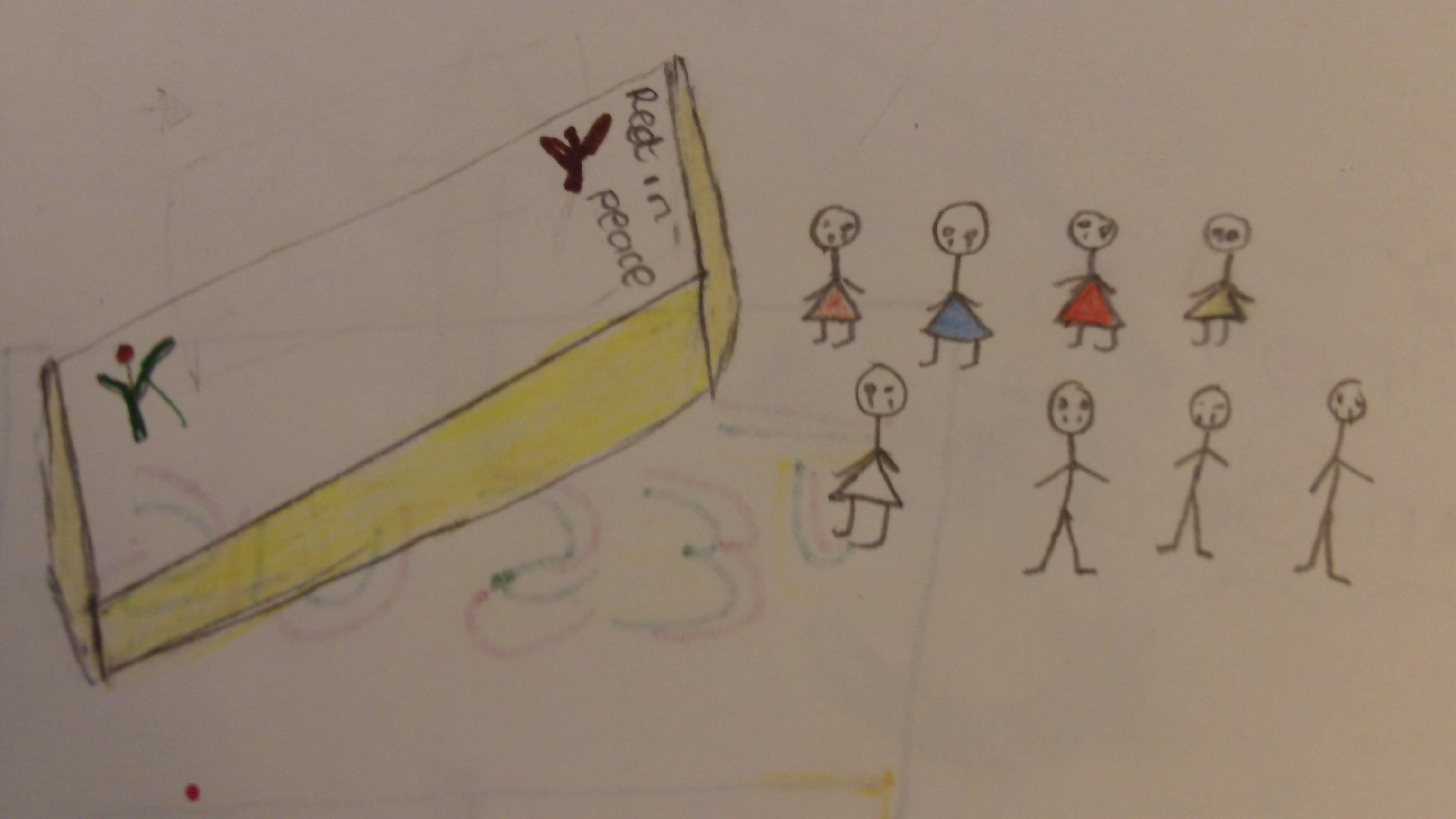
Going to school without school uniform and October 27, 2000 when I was 8 was the day that my father passed away.
Making progress for the future:

I am now in form four. I live with my ninez in Mhondoro. I always study my books in order to pass. My favorite subjects are Mathematics, Science, and English because I dream to be a nurse.

Hoping for the future:

This picture refers to my wedding day. May people come to celebrate my wedding day.
Continuing with blog posts:
Thank you for reading a story from one of the girls once again. It is amazing to me to see the themes within each story that really come out to show how the girls are similar but also different.
However even though I see commonalities between the girls when reading the stories I also see each girl as a unique individual that I am getting to know better through their personal story, just as I hope you are as well.
June 20, 2011
Sharing the story of Deonicia Zono:

Her story begins when she was born in 1993. She was the last born child in her family. Unfortunately she lost her mother in 1997 to HIV and her father left the children in 1998. After losing both of her parents Deonicia began living with her aunt, which is who she dedicated her Hero book to.
I dedicated [my book] to my aunt because she has been [there for me] since I was young and my mother died. She loved me as her only daughter. She always corrects me when I am wrong and she is kind.
Revealing Deonicia’s life:

Deconicia hasn’t had to deal with the memory of seeing her parents die, but with another type of pain.
The past sad memories are I don’t even remember my parents faces. It’s really hurtful because I didn’t grow up with them.
Looking at her past and present schooling:

Unfortunately because Deconicia only had her aunt to support her she wasn’t always able to go to school.
When I was still at primary school sometimes I didn’t go to school because of the school fees.
Now in the present Deconicia is doing much better.
Since God [gave me the gift of] Tariro Org my life just change from that day. I was able to go to school without any worry that I would be sent away.
Looking into the future:

Deonicia hopes to become a flight attendant or model when she grows up and is also interested in continuing to play Marimba.
When I grow up I want to be an air hostess or a model. I really believe that one day I will achieve my goals. I also want to be an Marimba player. After I achieve my goals I would like to get married and have two kids.
Thank you:
Once again thank you for taking interest in these girls lives and reading about their stories. I am going to continue posting Hero stories every once in a while so the readers can get to know who they are supporting. It is hard to draw a connection to the girls because they are so far away, but it is important to do so because each one has their own story and background that is important for each of us to know.
June 13, 2011

The first case of HIV was discovered by scientists in June 1981, since then the epidemic has continued to grow. With it’s growth we have seen a numerous amount of deaths, but there have also been strives. Partners in Zimbabwe wrote an article about the HIV epidemic specifically related to Zimbabwe after the UN council meeting in New York. The article discusses Zimbabwe’s challenges, achievements, and opportunities.
Looking at the challenges Zimbabwe faces:
In the world Zimbabwe still has one of the highest HIV infection among all the countries. “It carries the third largest HIV burden in Southern Africa and has one of the highest rates of premature adult mortality, largely due to HIV-related illnesses.”
The second most significant source of new infections is mother to child transmission. “Approximately 1 in 3 infants born to HIV infected mothers are HIV infected.”
AIDS still remains a leading cause for death in Zimbabwe. “It is estimated that in 2010 alone 59,318 adults and 11,981 children died of HIV-related illnesses.” The other tragedy is that, “AIDS related deaths have left in their wake large numbers of orphans and vulnerable children: it is estimated that 25% of all children in Zimbabwe have lost to AIDS one or both parents.” However Zimbabwe is committed to achieving the goal of zero new infections.
“Latest estimates place the 2010 adult HIV prevalence at 13.13%, which brings the estimated number of people living with HIV to about 1.2 million, including 145,225 children under 15.”
Looking at Zimbabwe’s achievements:

Even though there are 1.2 million people living with HIV the percentage of new cases every year continues to decline. “The first cases of AIDS in Zimbabwe were reported in 1985. For the next decade, HIV prevalence continued to rise and peaked at 29% in 1997. HIV prevalence has fallen significantly since the late 90s, down to 16.06% in 2007 and further down to 14.26% in 2009.”
Zimbabwe has also done with with making the antiretroviral treatment more accessible to the people. “By the end of 2010, a total of 314,927 adults (60% female) with advanced HIV infection were on ART representing coverage of 54% based on the revised (2010) WHO guidelines, up from just 8.3% in 2005. A sizeable number of children were initiated on ART: 32,430 children were receiving ART by the end of 2010, which constituted about 37% of the total number of children in need of ART, which was estimated at 89,490. It is estimated that annual AIDS-related deaths decreased from 123,000 in 2006 to 84,000 at the end of 2009.”
Looking at the future:
Through all of these messages coming from different sources we all must stay positive and continue to look for the light at the end of the tunnel. It is troubling to see how many people are living with HIV, but it is inspiring to see how the number of new infections in decreasing.
It was interesting for me to see how many mothers pass on the condition to their children. Through seeing how many new children are infected I believe that it is more important now than ever for Tariro and organizations like it to continue sponsoring young girls and keeping them in school. Stopping the spread of HIV to these girls will not just stop with them, but if they succeed because having the ability to go to school they won’t be a part of the statistic of mothers that spread HIV to their children. The cure will not just come from an immediate solution, but a long term one in which we break the cycle of girls receiving the condition and spreading it on to their kids.
June 6, 2011

According to a recent article from PlusNews Global we have now reached the third decade since the first case of HIV was diagnosed. “An estimated 30 million people have died, another 34 million are living with the virus and an estimated 7,000 new infections occur every day.” However according to the article the news isn’t all bad. We have also seen a 25% decline between 2001-09 for the new cases of HIV. Also last year a record 1.4 million people started antiretroviral drugs. The article categorizes the successes as well as the failures for treating HIV in recent years. The following statistics have all been contributed a new report from UNAIDS.
Looking at the pure numbers:

– Between 1981 and 2000, the number of people living with HIV rose from less than one million to an estimated 27.5 million;
– In 2010, an estimated 34 million people were HIV-positive;
– The number of new infections has steadily declined, with the annual rate of new infections falling by nearly 25 percent between 2001 and 2009.
Treating the infections:

– Between 2001 and 2010, the number of people receiving antiretroviral treatment rose nearly 22-fold, with an estimated 6.6 million people on treatment globally by December 2010;
– An estimated nine million people who qualified for ARVs did not receive them.
Looking at the future:
While we have seen an increase in the number of HIV cases we have also seen a decrease in the rate of new people being diagnosed. This statistics may seem overwhelming but it is important that we realize that in time we can continue to work towards a goal and solution.
I wanted to share these statistics with you because they remind me of how many lives are being affected in this world but also make me hopeful that in the future the rate of newly diagnosed will continue to decline.
It is Tariro’s mission to prevent the further spread of HIV by educating young girls. Through educating these girls we can make it less likely for them to fall in the same pattern as their parents did and help them to achieve a brighter future with education.
Thank you for reading this week!
Here is the link to the actual article if you’re interested in reading more: http://plusnews.org/Report.aspx?ReportID=92883
May 30, 2011
Coming back to the heroes stories:
If you started reading the blog after this last October then you may have missed out on the introduction to the Heroes stories. This last August a therapist named Lauri Benblatt traveled to visit our Tariro girls. At the annual empowerment camp Lauri introduced the idea of the Heroes books. These books were written by each girl to use during group counseling sessions. These books show the reader the world these girls have been in and the obstacles they had to overcome. Some parts are hard to read because the tragedy is so great, but there is something hopeful each girl has found in their hero.
Today I would like to discuss the story of one girl with you.
Introducing Natalie S.’s Hero Story:

Natatlie’s past has been a difficult one and there are many obstacles she has faced, however when Natalie had no place to live her grandparents took her in.
I am a 16 year old student in college. I’m in form 4 class. I live in Glen Norah A with my grandmother, grandfather and my aunties and their children.
Natalie’s grandparents took her in because when she was born her mother was still in school and her father wanted to have her aborted. Even though her grandparents didn’t have very much money they worked hard to send her to school.
When I started my primary education my grandparents had the burden to send me to school, buy my school attire, pay school fees and other things needed at school. My life was difficult because sometimes I went to school without complete uniform e.g. proper shoes for the school, a shorter uniform or even without socks. Sometimes I was sent home and not allowed to attend lessons because my fees was not paid.
Natalie’s grandparents tried very hard to send her to school. They sacrificed buying things for themselves in order to pay for Natalie and she finished primary school. After attending primary school Natalie went on to Highfield High then Great Stride College. Natalie describes her life as a student with Tariro:
My life is now better because Tariro is there for me now to pay my fees, give me pads, exercise books, jersey pens, pencils, and school uniform and bags. I thank Tariro for everything they are doing in my life because if it was not for them it could be hard on me and my grandmother to send me to school, pay all the fees, buy my school uniform and other things required.
With Tariro’s help Natalie wants to achieve her hopes and dreams:

Natalie's dream family.
After I finish my education I hope to become an Accountant. I always try my best to pass my “O” Level studies because without them I will not do anything. If I pass, have a diploma and have a job and earn better I hope to help other girls who need help like money for school fees, uniforms and other things that I can be able to do for them.
I hope one day I will be able to have a big family, a nice house and a car and be happy in my life.

How Natalie describes her ideal husband.

A drawing of her dream car.
Natalie has many aspirations in life and with Tariro she was able to finish secondary school and go onto college.
Thanks for reading:
If you’re interested in the other Heroes Stories or you would like to read them again I have them linked below to each girl. Thank you for reading Natalie’s story. It is not just important for our readers to know statistics and learn about the education system in Zimbabwe, but also to know the lives of the girls we’re supporting.
May 23, 2011
 Event details:
Hokoyo partnered with master Zimbabwean musicians Musekiwa Chingodza and Ambuya Beauler Dyoko to record their first CD, Chipembere. Since then they have studied with many Zimbabwean and American teachers. They have just released their second CD, Hokoyo Live, available online at http://www.cdbaby.com/cd/HokoyoMarimba.
Hokoyo is Casey Barkan, Michael Beardsworth, Jory Christiansen, Will Dickman, Maceo Gutierrez-Higgins, Jake Roberts, Gary Spalter, Eliot Stone, Mandy Walker-LaFollette, Alex Weeks, Grace Wittig and Mason Kline.
Mudzidzi is an outgrowth of an mbira class taught by Joel Lindstrom at the Kutsinhira Cultural Arts center in Eugene, Oregon. A small group from this class organized to perform for an artists’ forum which meets weekly at a Eugene coffee shop for the purpose of drawing or painting musicians as they perform. Mudzidzi has played for this gathering six times since March 2009.
May 19, 2011

Tariro student Noleen C.
Many of Tariro’s supporters will remember Noleen C., who was born with spina bifida, and uses a wheelchair. Last year, Tariro raised over a thousand dollars to cover Noleen’s hospital expenses during a medical emergency. In discussions with Noleen’s mother, Tariro learned that her ongoing medical issues were in part related to the low level of care she was experiencing at school. In response, we made a commitment to transfer her to one of Zimbabwe’s best facilities for students with disabilities, the St. Giles school.
Tariro’s program coordinator, Fadzi, has recently sent us an update, letting us know that Noleen indeed changed schools at the beginning of this year, becoming a boarder at St. Giles. She seems to be doing much better at St. Giles, which offers ongoing physio-therapy, and has medical staff readily available for students. Based on the intake assessment done at St. Giles, Noleen is repeating a grade, which we hope will enable her to progress academically as well as physically in her new environment. While St. Giles is almost twice the cost of Noleen’s old school, Tariro is committed to accommodating the special needs of this incredible young woman.
Tariro’s ability to offer personalized assistance to individual students with special needs is one of the things I love most about our work. As we continue to sponsor the same student over many years, we have the unique opportunity to see the positive impact our work is having on an individual level. We’ll offer another update on Noleen’s progress later this year. And as always, we welcome donations toward helping us cover the costs of Noleen’s education! You can make a one-time donation, or sign up as a monthly donor, through JustGive. Thanks again for your support of this student with special needs!
May 16, 2011

Students who finished high school in the Mhondoro rural areas with Tariro's support.
Greetings readers! I hope you’re all doing well and enjoyed the last post relating the HIV/AIDS statistics to our student Ashley M. This last week I went to a presentation on the University of Oregon campus from Half the Sky Foundation and that’s what I would like to write about today.
“Half the Sky” and the challenge of gender equality:
Sheryl Wudunn, a charismatic and eloquent speaker, gave an amazing presentation at the University of Oregon last week. The main point of Wudunn’s entire presentation was to show how the world we live in is full of gender inequality. In her speech she addressed three main points relating to this: a lack of women’s education, a serious sex trafficking problem, and a high maternal mortality rate.
At the beginning of Wudunn’s lecture, she discussed how many girls remain uneducated, as many parents believe once they finish school they will just end up working at home or in the fields. For this reason many women never enter the formal labor force because of inadequate training or lack of opportunity. The next problem that Wudunn mentioned is that women around the world are being affected by sex trafficking, with over 800,000 people “trafficked across international borders, and that number doesn’t include the people trafficked within their own borders.” She also discussed how the treatment of these women is becoming more detrimental every year because their value to the buyers is declining, causing buyers to not care as much about the girls’ treatment because they can simply buy a new one. The last and final point that Wudunn brought up as a serious issue was the high number of women that die during labor. In Niger, for example, “1 in 7 women can expect to die during birth.” The points Wudunn made in her presentation were very disheartening, yet she also presented the audience with an image of hope, giving examples of a women or girl who had overcome significant obstacles. These stories were very inspiring and made a very big impact on me.
Relating “Half the Sky” to Tariro’s work:
While Wudunn covered an array of issues affecting women today, the one that is most important in relation to Tariro’s work is women’s education. Wudunn discussed a couple of stories about girls who became successful when given the opportunity to go to school. Throughout the presentation she stated several times that, “girls just need to be given the chance.” Providing this type of educational opportunity is exactly what Tariro is doing. By sending girls to school, we are giving each girl an opportunity to be successful.
Success stories versus human rights:
In a conversation with Tariro’s founder Jennifer after the lecture, however, we remarked that despite all of the wonderful success stories WuDunn had to share about girls that she’s interacted with, she didn’t address what happens to the girls who don’t rise to this kind of outstanding level. The hard thing about this subject is that when organizations only discuss success stories in regards to education, does it begin to imply that the girls who don’t succeed don’t deserve an education?
It is unrealistic to assume that every single girl will receive a full ride scholarship to a college in America, or that they will pass their O level and A level exams. And then this brings us to the question of who does deserve an education. An education is not something that should be chosen for a person but something that should be provided for every one. Every single person on the planet has a right to learn and succeed in life. Education is a basic human right, it is something that every one should receive no matter what social status or gender they are. For this reason it is important to look at the success stories but also look beyond them and at the grander scheme of things.
Back to our readers…
While we love to share the stories of some of our incredibly successful students, success isn’t always getting a scholarship to attend university or finish A level study. Sometimes, it’s simply learning how to read, staying enrolled in school, or getting caught back up to grade level after a long absence. What do you think? How can organizations emphasize the successes stories of particular individuals without losing sight of the basic issues of human rights guiding their work? How might we tell the stories of exceptionally successful students without downplaying equally important, but much smaller successes in other students’ lives?
Thanks for reading, and for your comments.
May 9, 2011

The county and its flag.
Introduction:
Hello readers! I hope that you liked last weeks post explaining the how the school system in Zimbabwe works. In this weeks post I want to take a look at the specific HIV/AIDS statistics in Zimbabwe. Looking up these statistics really put the epidemic into perspective for me and truly opened my eyes.
I would also like to talk about a personal story of one of our students, Ashley M., and talk about how HIV/AIDS has effected her life.
Astounding statistics in relation to Ashley M.:
Ashley’s story:
Ashley is attending Herentals college right now. Both of her parents have died, her mom January 31st, 2003; and her dad December 5, 2007. According to UCSF the year Ashley’s mother died there were 170,000 HIV/AIDS related deaths, and 140,000 the year her father died. Zimbabwe has a higher number of orphans, in proportion to its population, than any other country in the world, according to UNICEF. In fact, as many as 1 in 4 children in Zimbabwe are orphaned as a result of parents dying from AIDS.
After her parents died Ashley and her little sister Ellen moved in with their grandmother and two younger uncles. She said that some of the difficulties she faces is her relatives not having enough money to buy “food and soap.” But after Tariro began sponsoring her, “a lot changed.”
She said that after Tariro came into her life her, “school performance improved as well as her emotional state.” She began worrying less because she didn’t have to be concerned about finding ways to pay her school fees. According to UNICEF (United Nations International Children’s Emergency Fund), in 2009 there were 1,000,000 children orphaned by AIDS. Sadly only 95,000 of those students went to school. But Ashley is now one of them because of Tariro’s support.
At the end of Ashley’s interview she said something very moving, “I will be different than the other children who didn’t have the chance to go to school.”
Ashley is one example of an orphan is Zimbabwe who is effected by losing parents to HIV/AIDS. If you look at the thousands of people who died in the same years as her parents it becomes astonishing to think about how many children are effected and go through life changing events because of this epidemic.
Thinking about these statistics:
Going beyond the statistics and relating it back to Tariro’s mission sheds some light on how important our work is. Out of the 95,000 orphans that are attending school, only 39,000 of those are girls. Tariro’s work continues to be more important than ever with us sending girls to school each year and helping make that number a bit higher.
Thanks:
Once again I thank you for your support by just doing the reading. Learning these statistics really opened my eyes. To realize how big the scale is and how many people are effected makes me even happier that I am participating in Tariro’s work.
You must be logged in to post a comment.